So Midnight Circus had its first reading, and it was glorious.
For
those not familiar with Midnight Circus--not enough are--it is EAB Publishing's
flagship publication, a quarterly literary mag that attracts talent
from around the world. That's no joke; the submissions have come from a
worldwide pool. It's awesome.
I happen to be the Production
Manager of this fine publication, which is a pretty simple job despite the fancy title. All I do is make sure that every submission received is reviewed by people far more qualified than me. Well, those types of people are easy enough to find. Once
the stories and poems are whittled down, I format the interior so that the scattered and
various submissions become a book. It's fun. I get that little thrill that comes from creating a new piece of art without all of the torture and agony that often accompanies such an endeavor.
When it comes to the
reading, I wasn't sure what to expect. As mentioned, this was the first one. Things usually go wrong the first time you try something. Would anybody show? Where was this UNO-Kaneko Library? Or is it the Kaneko-UNO Library? What was
EAB thinking with this? Do people really come out to hear writers read?
Turns
out, they do. Indeed they do. Somehow or another, I ended up with the job of adding
chairs. Seems like a very Production Manager-y thing to me, so I was all for it. Seats would fill up, new arrivers wouldn't have anywhere to sit, and so I'd go to the back and grab more. Easy enough-- people seemed to arrive in pairs, so I'd grab a couple, set them up, and then grab a
couple more, just in case, knowing nobody else would show up because we were already pretty full.
Then I'd repeat the process.
I think we added an extra 25 chairs to the 30 or so initially present--the people kept coming. It was great.
And
why wouldn't they come, because the lineup was fantastic. Let's run it down. These aren't all names you might know now, but with any luck, you will soon. A.E. Stueve was killing it as MC. The readers: Jeff Lawler. Carrie Helmberger. Liz Kay. Kristen Clanton. Jeremy Johnson. Barbara Schmitz. Julie Rowse. Karen Shoemaker. All of them have appeared in Circus. Lots of talent, which was evident from the first reader, and they kept on coming. Honestly, this was the first reading I've ever attended, it always seemed to me that it would be a little awkward to hear writers read because it feels awkward for me to share my stuff. Well, I get it now.
Myself, I went through a bevy of emotions. This piece isn't about me,
it's about a great night, but I can't help myself. As these creators kept reading, and knocking the breath out of the room, my
thoughts went something like this:
This is great. Good stuff. Wow,
great writing. This is really good. Ha ha, that was funny. So was that. Holy crap, I can't take it anymore--stop
being good, people, you're making me feel bad. I call myself a writer?
These are writers. I quit. I retire. Finished! Done! Matter of fact, I should just leave the room and return as a simple observer, because who am I to pretend I can lick these people's boots? Go out a wannabe writer and come back as whatever the hell I am.*
And so on. You know, self-doubt and all that stuff. But
then something shifted, and while this great writing continued to come
at me, I had a realization. An epiphany, if you will. I began to think
crazy thoughts, like, well, maybe I do belong here. I thought of things I had written that might lack in certain areas, but can hang in others, and I thought, you know what, I could do this, too. My
work could share the stage with these insanely creative people. Maybe I
don't, um, suck? (Hey, why don't you buy my new short story collection The Legend of Hummel Park and find out for yourself, huh?)
So that was fun.
Great night.
*This presents a problem, because if writing isn't about figuring out who the hell you are, and who we are, then I don't know what it is.
Friday, October 9, 2015
Saturday, October 3, 2015
Review of Lies Jane Austen Told Me
As a writer, I tend to believe that, ultimately,
there are two reasons people write. Some do so simply because they want to,
perhaps expecting notoriety, financial gains, personal
entertainment, or something else. Others write because they have
to. Myself, I have to write: there are stories rattling around in my head,
stories of fiction, and they won't leave me alone until I get them out. I
either write, or go nuts, probably.
I say this not to talk about my own
writing, as much as I enjoy doing so, but to discuss Julie Rowse's book Lies
Jane Austen Told Me. In truth, this is not a work I would have sought
out—the dating life of a Mormon woman? No offense, but what do I care? Yet after blazing
through the first 90 pages or so, I found myself enjoying the book and eager to
read on.
Still, as much as I was enjoying the book, I won’t deny that I would sometimes stop to grapple with a question: what made
Rowse decide this story had to be told? The book is well written, yes,
and I was intrigued by a culture I knew little about. But that didn't give me my answer. What made Rowse want
to share what is a highly personal story with the world?
Then, around the midway point,
Rowse began to write of her fiancé. He had been mentioned, briefly, earlier in
the text. At the time, I wondered why the mention had been so scant. Clearly, this was
an important part of her story. Here was a woman who was dying to be married,
born in a culture that apparently believed the ultimate goal of a
female was to become a wife and a mother, and yet she only wrote briefly of a
full-fledged fiancé without going into further detail?
But as I read more about this man, it all became clear.
Why did Julie Rowse decide to tell
her story? I could be wrong, but I don't believe that she wanted to write this
book. I am not certain she was bursting to showcase her personal insecurities
and difficulties. No, I believe Rowse felt she had to write
it, if not for herself, than as a potential warning for others. People who are willing to
sacrifice their own personal integrity to live up to what we—all of us—believe
society demands of us. Set in the context of this world, one that Rowse has
respectfully brought us into (she is quite clear in stating the many benefits
she has derived from her faith), this Mormon culture that seems to value one
role for woman above all others, we are given a stark example of the many outside
pressures people allow to measure themselves.
This book dares to ask—is it
worth it? Are there costs that we should refuse to pay? If so, what are they? What line are we not willing to cross to meet the expectations society has put on us?
Rowse needed to tell this story.
Chances are, you need to read it.
(Full disclosure: I was given an
advance copy of this book as EAB Publishing had published my last book. I did some minor copy editing on it while reading it. It had
no impact on my personal thoughts of the book.)
Thursday, October 1, 2015
Exhaustive Review of All Four Sherlock Holmes Novels and 56 Short Stories
There's no bigger waste of time than reviewing the Sherlock Holmes series. They are great, everyone that can read has read them, and no doubt everyone has enjoyed the 4 novels and 56 short stories written by Sir Arthur Conan Doyle as much as I did.
Wait. You haven't read them? Oh, you read them many, many years ago? Or you read a couple of them, or maybe just one, because they made you in high school? My God, man, you've found an even bigger waste of time than reviewing the original Sherlock Homes tales, which is reading reviews of those tales when you could be reading them right now.
Tuesday, September 29, 2015
Review of Swiss Family Robinson
I love reading the classics, particularly adventure classics, but Swiss Family Robinson didn't do much for me. There were strong passages, but for the most part, the story consisted of the family finding an animal, which they would tame and make a pet of, or of them finding another sort of animal, which they would kill and eat. The Disney version wisely added pirates. This book could have used pirates. The end.
Tuesday, September 22, 2015
My Review of Bloody Lies
Say Nebraska decided to hold
elections for something insane, like an official state crime. There would be
little debate; the top spot would go to the infamous 1958 Charles Starkweather
killing spree, which stretched from Lincoln to a few miles past the state
border into Wyoming. Inspiring both films and music (Bruce Springsteen’s Nebraska, the films Badlands and Natural Born
Killers, among others), the impact of that notorious crime has been widespread.
But if it was up to me, we’d all
take a closer look at another horrific tragedy: the murder of a happily married
couple, the Stocks, while they slept in their farmhouse in Cass County,
Nebraska. In Bloody Lies, author John
Ferak gives us the opportunity to take such a look. This crime, and most
especially the subsequent investigation, deserve as much attention, if not more,
than the one glorified by movies and music. The lessons learned are simply too
important to ignore.
Bloody Lies opens with a description of the murder. It is frank and
unflinching, but necessary for us to recognize the heinousness of the crime.
Included with this are three photos of the victims. Needless to say they are
hard to look at. Whether or not they were required is tough to say, but it
cannot be denied that the pictures allow us to see for ourselves exactly how
brutal the crime was.
From there, the book essentially
splits into two halves. The first covers the investigation of the crime through
interrogations, crime scene analysis, and so on. Ferak unreels the facts in it
a straight forward fashion, letting the story speak for itself—and what a story
it is. I was familiar with the generalities, having followed along in the Omaha-World Herald, yet I found myself enrapt.
As uncomfortable as the material can be, the quick pace of the book kept me
completely involved.
Ultimately, despite having solid
alibis and dubious motives, two individuals are held responsible. Why? Because
the police have a confession. We learn that this confession derived from an
ethically troublesome and frightening interrogation of one of the suspects.
Damn the facts, the investigators have what they want and they’re going to run
with it. Reading the excerpts of the interrogation quoted at length, it seems
clear that the suspect, Matt Livers, is all but fed a confession, the words very
nearly put in his mouth. It is difficult to resist feeling anger when Livers, a
young man that has a slight mental handicap, is instructed to “stand up” and
admit his crime. Incapable of understanding the abstract meaning of the phrase,
Livers literally stands up from his
chair.
Monday, August 31, 2015
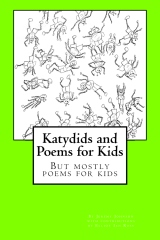
Review of Katydids and Poems for Kids
There
are all kinds of good books, and I don’t much care where they come
from, so long as they come from somewhere. Keep ‘em coming, I say. This
one?
Katydids and Poems for Kids: But Mostly Poems for Kids?
I don’t know what recesses of Jeremy Johnson’s mind these poems sprung from. Like I said, I don’t care.
I’m just glad they’re in print, where we can all enjoy them.
Now,
I have met Jeremy, and he’s a super guy. But I’ll be honest. It’s a
good way to be, because lies tend to trip over themselves, and we don’t
want that. See, I wasn’t sure I wanted him writing kids that I would
read to my poems—wait
a second, let’s try that again. I wasn’t sure I wanted him writing
poems that I would read to my kids. I wasn’t certain because that’s kind
of a big thing, right? You can’t just sit there and read them any old
thing. I’m trying to raise future high achievers
in a way that I can live through them vicariously, because I haven’t
done much myself, and I can’t risk feeding them rubbish.
So
I did something very wise—I opened the book up and began to read for
myself, before endangering my children’s futures. If it was bad, no big
deal, because I can always spare the brain cells, being that I don’t
drink nor read
Shades of Grey books. I gots plenty of brane sales so it’ll be….good.
Friday, July 31, 2015
The Phantom of Faerie Mountain Review
This is a very enjoyable book. The characters are engaging and relatable, with the bulk of the fast-moving story taking place in a perfect Scottish setting. Abby is the heroine who gets sucked in to the action very early, literally landing on the hero, Rory.
It was refreshing to not have Abby's primary concern be sucking face with the hero. Her mind is on her mission, and Rory and Abby treat each other as people rather than objects of lust. The handling of Rory's Scottish accent was particularly well done--there's enough to absorb us, but it is never difficult to read. A mysterious hound, Finlay, dips in and out of the story to gently lead Abby on her way; I was reminded of Aslan from the Narnia series, without the baggage of having to symbolize a deity. The story has a satisfactory conclusion while leaving the door open for the rest of the planned trilogy, which is not always an easy feat to accomplish. Overall, I enjoyed it, and think most readers would as well (it is appropriate for all ages).
Friday, July 3, 2015
Rainbow Blog #7
Short and sweet today.
15
Big
chapter, but let’s not dwell on that—let’s focus on this great line
instead: “Months are different in college, especially freshman year. Too
much happens. Every freshman month equals six regular months—they’re
like dog months.”
Nailed
it. So true. I can remember taking finals and looking back at the start
of the semester like we had ridden to school on a horse and buggy. Then
you’d go through it all again the next semester.
Lots of romance stuff in this one, and roommate's boyfriend is now roommate's ex-boyfriend. Well, he has been for awhile, but they neglected to tell..well, anyone really.
Subscribe to:
Posts (Atom)